All breakdowns+3.0 R
EURUSD · SHORT · 20 Jul 2026Discretionary
Two valid signals, one allowed trade — EURUSD vs. GBPUSD
- Context
- A rare morning: the mechanical rules fired a valid Model 1 signal on two pairs at once — EURUSD and GBPUSD. Both met the same conditions (sweep, close confirmation, DXY confirmation), but the rule is clear: at most one trade per strategy per day. A choice had to be made.
- Pre-trade — preparation
- The deciding factor was relative strength: sterling was holding stronger against the dollar than the euro at that moment, so shorting EURUSD offered a cleaner path down than shorting GBPUSD. The decision was made before entry, not in hindsight — which is exactly what defines a discretionary exception.
- Trigger
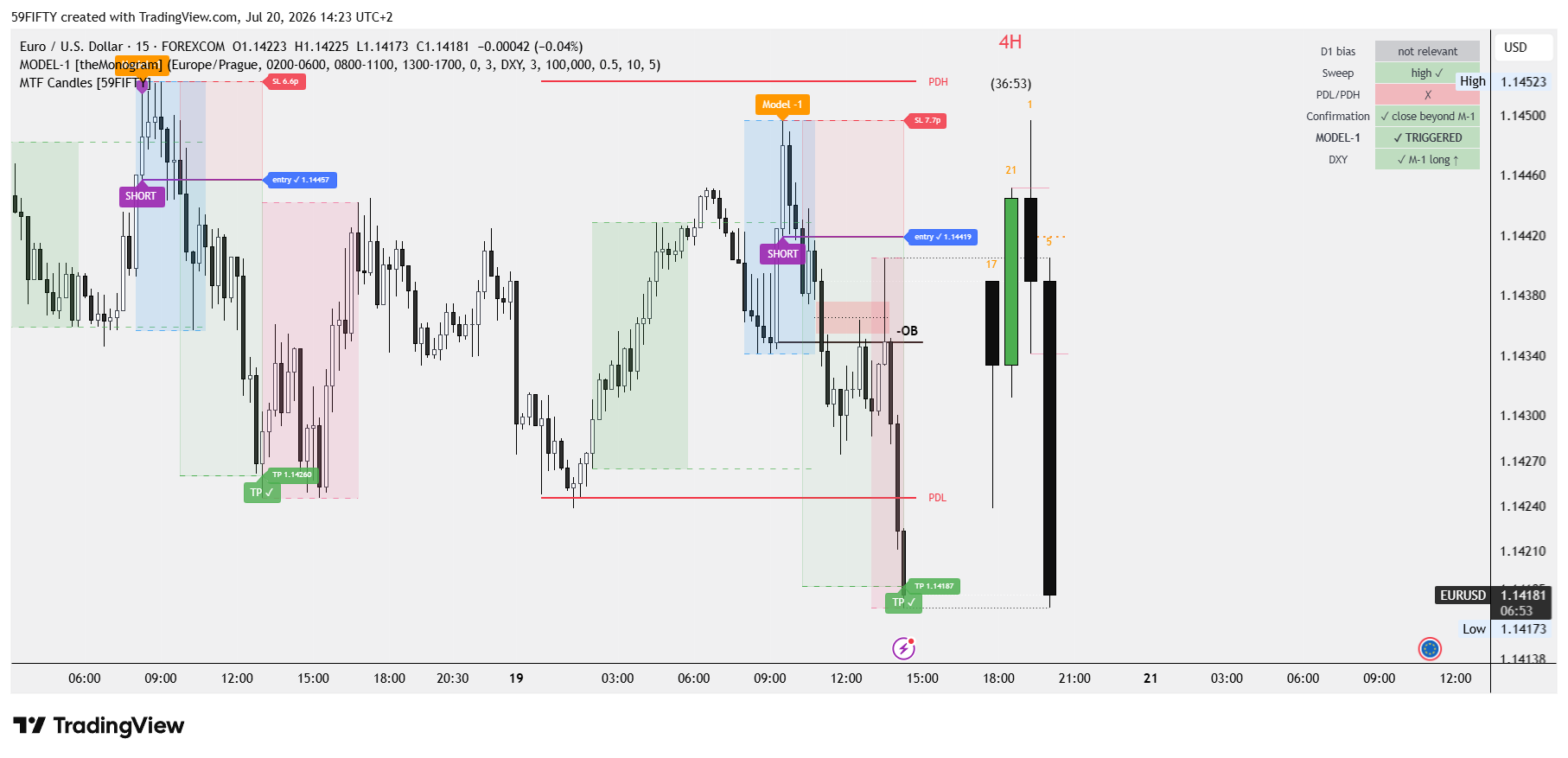
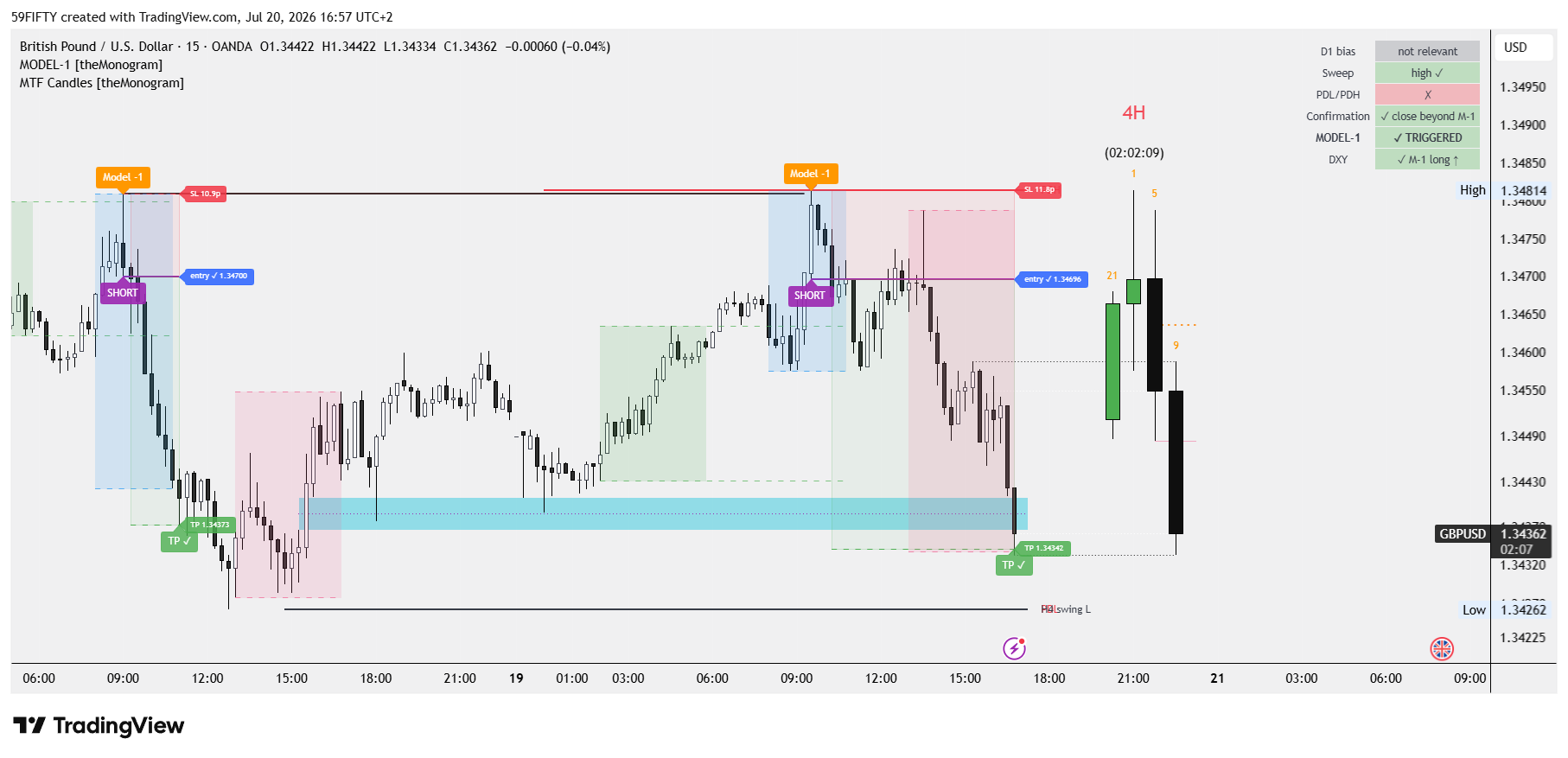
- A sweep of the Asian session high and a close back below the Model 1 level confirmed the EURUSD signal; DXY mirrored it long. GBPUSD had a technically identical configuration at the same moment.
- Entry & management
- Short 1.14419 at the retest of the Model 1 level, stop 7.7 pips beyond the sweep extreme, fixed 3R target. Set & forget.
- In-trade — while in the position
- No interference with the position — price ran almost straight to the target.
- Result
- TP hit at 1.14187 noticeably faster than the comparable (untaken) GBPUSD signal, which didn't reach its own target until the afternoon. The faster move matched the relative-strength read — the euro was the weaker side at that moment.
- Post-mortem — the lesson
- In fairness: a GBPUSD short would have won too under the same rules — it just reached target later. So this trade doesn't prove the relative-strength read carries an edge; it only shows that the one-trade-a-day rule forces a real decision that would otherwise never get made. Whether this selection filter adds value beyond "take the first valid signal" is something only dozens of similar situations in the journal will show.