Anyone can read my trading journal, no login required, at journal.themonogram.cz. Every trade is recorded on the day it happens — winners and losers, mechanical and discretionary. This article is about why I did that and what I promised myself in return.
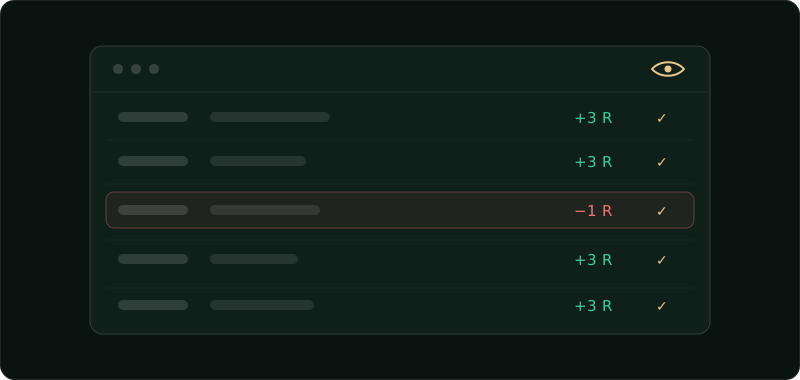
A journal without losses is marketing
Trading content has a systemic problem: only wins survive. Losing trades don't get screenshotted, shared or remembered. The result is an environment where everyone looks profitable — and where nothing can be trusted.
The only answer I know is a record kept forward: the trade is written down on the day of entry, the result is filled in, nothing is deleted afterwards. A loss gets the same space as a win — on the Trades page you'll find a losing trade dissected next to the winners, and in the journal every stop-loss.
Being public changes behaviour — and that's the point
This is the less obvious half. A public journal isn't just proof for readers; it's a discipline tool for me.
The moment my hand itches to move a stop or take a second trade after a loss, I know anyone will see the record. I can't polish it, I can't leave it out. A commitment that would otherwise exist only in my head suddenly has witnesses. Behaviourally, it's the cheapest reinforcement of discipline I've found — it costs nothing and acts precisely in the moments when the rules hurt.
What is not public
Transparency has deliberate limits, and it's fair to name them:
- Account size and amounts. Results are kept in R-multiples; the process is public, the wealth is private.
- Personal notes and screenshots. Raw psychology notes stay in the private part of the journal — I write them for myself, and an audience would kill the honesty.
- Signals. The journal is a record, not a recommendation. I publish trades as data about the model, not as an invitation to follow.
Small numbers, said out loud
The journal is young and the numbers are small — a handful of trades, a handful of R. I won't draw conclusions from them and I'd advise you not to either; a reasonable first sample is on the order of 20–30 trades. Until then, only one thing holds: the record is running, the rules are being followed, and everything is visible.
If you want to follow the journal over time, I send a monthly recap by e-mail — sign-up is on the Resources page. And if not, the journal is simply open. That's how it was designed.