Look through the trades in the journal and the stop-loss sits a different distance from entry every time: 6.6 pips, 7.7 pips, 10 pips, on one occasion 19 — "wider grab than usual," as the entry itself says. That's not inconsistency. It's a rule that follows the structure of the chart, not a fixed number — and this article explains exactly where the stop ends and why.
One candle isn't enough
A sweep, as Candle Range Theory describes it, is the moment price pokes through a range boundary and closes back inside. On the chart it usually looks like one standout candle with a long wick — and the obvious, simplest thing is to put the stop right behind it.
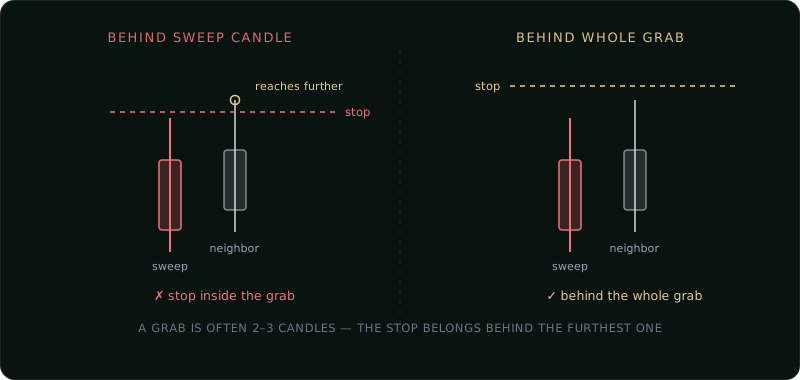
The problem is that the grab as a whole is usually two to three candles, not one. Price often takes liquidity in stages: one candle reaches a little further, the next reaches a little further still, and only then comes the close back inside the range that counts as confirmation. When the stop sits only behind that last, "visible" candle, it can end up sitting lower than a level price already visited once within that same grab.
Where the grab actually ends
The rule Model 1 runs on is therefore different: the stop goes behind the extreme of the entire liquidity grab, not just behind the sweep candle. If a neighbor within the same order block poked further than the candle that triggered the signal, the stop belongs behind that one instead. Otherwise it sits inside the very structure it's supposed to be protected by — which means price can take it out with an ordinary return to a level it already visited, without that saying anything about the setup itself.
The difference looks small on a chart and matters a lot in practice. A stop "behind the sweep candle" looks precise. A stop "behind the whole grab" sits a few pips further out — and those few pips are exactly what separates a genuine invalidation from getting clipped by noise that's still part of the same liquidity pool.
Why it doesn't cost an extra R
This is where it's easy to think wrong: doesn't a wider stop mean more risk? Not in Model 1. Risk per trade is a fixed percentage of the account (0.3% live, the backtest ran on 0.5%), and position size in lots is calculated to fit that risk — not the other way around. The MODEL-1 indicator does this automatically: it places the stop behind the extreme of the grab and computes lot size to match, so the risk stays the same whether the grab is 6 pips wide or 19.
What changes is position size — fewer lots for a wider stop. So the real temptation doesn't run toward "make the stop tighter to feel safer sooner." It runs the other way: a tighter stop would allow a bigger position at the same risk, and that's the actual trap. It looks efficient, but it only raises the odds of getting stopped by noise inside the grab that never invalidated the trade in the first place.
What that looks like in the journal
That's why stop distances differ from trade to trade, and why they should. 6.6 pips is a narrow, cleanly defined grab. 19 pips means a wider structure — more candles, more liquidity, a slower taking process. Both are equally valid, as long as the stop sits behind what the grab actually is, not behind whatever candle happens to be the most obvious one.
It isn't complicated math. It's the discipline of not simplifying the chart's structure down to one candle just because that would be easier to work with.
The Model 1 checklist + monthly recaps
Leave me your e-mail — you'll download the checklist right away, and once a month I'll send a recap of the live journal: the numbers, trade breakdowns and what went wrong. When MODEL-1 ships, you get the invite first. No spam, no signals.
I post every trade on the day it happens on X — with the indicator screenshot, losses included.
@monogramfx— Follow on X