The Model 1 backtest (GBPUSD, 2012–2026, 111 trades, +0.24 R/trade) runs on 0.5% account risk per trade — that number is part of the math itself. On the FTMO challenge I'm trading live and publicly in the journal, I've risked only 0.3% since 20 July 2026. Same strategy, same entry rules, different position size. Here's why — and why it isn't an admission of doubt.
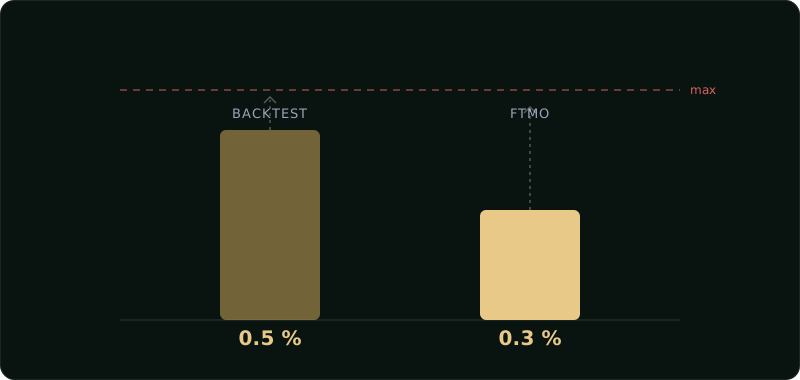
The backtest tests edge, not account survival
0.5% is the risk Model 1 was backtested with. A backtest has an infinite horizon and no outside ceiling — if a losing streak arrives, it just runs through it and logs it as a data point. It tests whether the strategy has edge. It doesn't test whether a specific account, with specific hard limits over it, survives long enough to show that edge.
An FTMO account has a fixed ceiling, a backtest doesn't
The 100k account: max daily loss $5,000, max total loss $10,000. Model 1 wins roughly 36% of the time — a streak of four, five, six losses in a row isn't an anomaly, it's a statistically expected feature of a sample with that win rate. A backtest just records that streak and keeps going. A prop account could end on it before the long-run edge has a chance to show up.
Lower risk per trade means more trades before I hit the ceiling, even in a realistic worst-case losing streak. It's the same math — just a different variable. The backtest asks whether I have edge. A live account with hard limits asks how many consecutive losses I can absorb before I get the chance to show it.
History doesn't get rewritten
The February 2026 case studies on the Trades page still show 0.5% — because that's exactly what I risked at the time. The change applies forward from 20 July 2026, not retroactively. Rewriting the old numbers to match the new ones would turn the journal from a record into a pitch.
Conservative, not hesitant
The opposite logic would seem to follow — if the model works, why not risk more, not less? The answer sits in this specific account's history: I once let it drift down on trades taken out of boredom and impulse, not rules — I've written about that directly on the Challenge page. 0.3% now is a deliberate correction after that experience, not a lack of conviction in the model.
R stays the unit, not dollars
Whether I'm risking 0.5% or 0.3%, the journal logs the same thing either way: a multiple of R (see R-multiples, not money). That's why I deliberately don't line up the FTMO account's dollar figures — balance, target, limits — against the live R total into one reconciled number. This specific account also carries history outside this strategy, so that comparison would produce a misleading figure, not a clearer picture. I'd rather show the process — when and why the risk changed, and what was behind it — than one finished dollar number that wouldn't explain itself anyway.
The Model 1 checklist + monthly recaps
Leave me your e-mail — you'll download the checklist right away, and once a month I'll send a recap of the live journal: the numbers, trade breakdowns and what went wrong. No spam, no signals.